
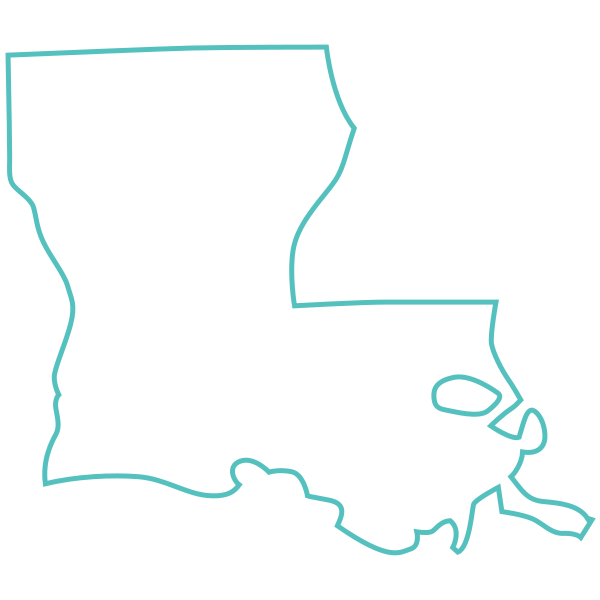
Parikh Financial proudly supports Louisiana businesses with tailored, white-labeled financial services. From startups to established companies, we streamline finances, optimize taxes, and drive growth with expert bookkeeping, tax prep, and outsourced accounting.
Outsourced Services
Timely, accurate, compliant books so you can focus on running the business.
Explore →Stress-free preparation and filing for businesses across every industry.
Explore →AP, AR, payroll, and reporting handled end to end by our team.
Explore →Accurate cap tables and equity records as you raise and grow.
Explore →Scalable data pipelines that turn your numbers into decisions.
Explore →

Louisiana has a personal income tax that, after recent reform, moved from graduated brackets to a single flat rate on individual income. The state taxes C corporations under a corporate income tax (also recently flattened) and historically paired it with a corporation franchise tax that has been on a repeal path. Louisiana imposes a statewide sales and use tax that local parishes and municipalities stack their own rates on top of, producing some of the highest combined sales-tax rates in the country and an unusually decentralized local-collection system administered parish by parish rather than solely through the Louisiana Department of Revenue.

And Accelerate Growth Across
Louisiana
Louisiana Business Tax Guide
Louisiana has a personal income tax that, after recent reform, moved from graduated brackets to a single flat rate on individual income. The state taxes C corporations under a corporate income tax (also recently flattened) and historically paired it with a corporation franchise tax that has been on a repeal path. Louisiana imposes a statewide sales and use tax that local parishes and municipalities stack their own rates on top of, producing some of the highest combined sales-tax rates in the country and an unusually decentralized local-collection system administered parish by parish rather than solely through the Louisiana Department of Revenue.
Louisiana does have a personal income tax, and as part of a 2025 reform package it replaced its old graduated brackets with a single flat rate applied to individual taxable income, paired with a larger standard deduction. For owners of pass-through entities such as S corporations, partnerships, and most LLCs, business profits generally flow through to the owners' Louisiana individual returns and are taxed at that individual rate rather than at the entity level by default. Because Louisiana's individual rate and standard deduction were just restructured and can be adjusted again, owners should confirm the current flat rate and deduction with the Louisiana Department of Revenue rather than rely on a prior-year figure.
C corporations doing business in Louisiana pay a corporate income tax on Louisiana-apportioned net income, which the 2025 reform also moved toward a flatter single-rate structure rather than the prior tiered brackets. Louisiana historically layered a separate corporation franchise tax on top, an annual privilege levy based on capital employed or net worth, and that franchise tax has been on a legislated repeal path that phases it out for corporations. Louisiana also allows a pass-through entity (PTE) tax election, letting eligible S corporations and partnerships elect to pay Louisiana income tax at the entity level so owners can work around the federal SALT deduction cap; because the election interacts with the new flat individual rate, it is worth modeling each year rather than assuming it always helps.
Louisiana imposes a statewide sales and use tax, and individual parishes and municipalities add their own local sales taxes on top, so the combined rate a business charges varies sharply by where the sale is delivered and ranks among the highest combined averages nationally. A defining quirk is that local sales tax in Louisiana has traditionally been administered and collected at the parish level by local collectors rather than entirely through the state, so a multi-location seller may register and remit with several separate parish authorities in addition to the state. Remote and out-of-state sellers can trigger Louisiana collection through economic nexus once their sales into the state exceed the threshold, and the Louisiana Sales and Use Tax Commission for Remote Sellers exists specifically to give remote and marketplace sellers a single point to register and remit statewide and local tax.
Operators who furnish accommodations for value in Louisiana, including hotels, motels, bed-and-breakfasts, cabins, campgrounds and RV parks, and short-term rentals, generally owe state and local sales tax on the rental charge plus additional local occupancy, hotel-motel, and tourism or convention-district taxes that are layered by parish and municipality. These lodging levies are notably non-uniform: jurisdictions such as Orleans Parish (New Orleans) and other tourism-heavy parishes impose their own occupancy and exhibition or stadium-district taxes, so two campgrounds or STRs in different parishes can face very different total tax burdens. While booking platforms may collect some state-level tax on facilitated stays, local occupancy and tourism taxes are frequently remitted to parish or local authorities, so STR and campground owners should not assume a marketplace covers every Louisiana lodging-tax obligation.
Louisiana businesses typically register for state taxes through the Louisiana Department of Revenue's online system, but because local sales and occupancy taxes are administered parish by parish, an operator often also registers with one or more local collectors or, for remote sellers, with the state's Remote Sellers Commission. Filing cadence varies by tax type and volume, with sales, use, and lodging taxes commonly filed on a recurring periodic basis and a return generally required even in periods with no taxable sales. Maintain clean records of gross receipts, exemption and resale certificates, nights rented, and tax collected broken out by parish and jurisdiction, since Louisiana's apportionment, local collection, and audits all turn on getting the location-by-location detail right and the operator remains liable for tax it fails to collect.
Louisiana's parish-administered local tax system is the recurring trap for owner-operated businesses: unlike most states where one agency collects all sales tax, Louisiana operators can deal with separate local collectors, separate registration, and separate combined rates for each parish they sell or operate in. Hospitality, campground, and real-estate operators should also watch for parish-specific tourism, convention, and special-district levies that ride on top of lodging charges in places like greater New Orleans and other visitor destinations. Because the flat income-tax rate, the franchise-tax phase-out, and parish rates are all in motion, treat any specific number as something to verify against current Louisiana Department of Revenue and local collector guidance before relying on it.
Parikh Financial keeps Louisiana owner-operators compliant across the state's unusually decentralized system, mapping sales-and-use nexus, handling parish-by-parish local registration and filing, and reconciling state versus local occupancy and tourism taxes for STR, campground, hotel, and multi-location clients. We also model the PTE election against Louisiana's new flat individual rate and track the corporation franchise-tax phase-out, so owners are not paying or filing on rules that have already changed.
Book a CallTax rules and rates change. General information for Louisiana operators, not tax advice — confirm current requirements with the Louisiana Department of Revenue or your Parikh Financial advisor.