
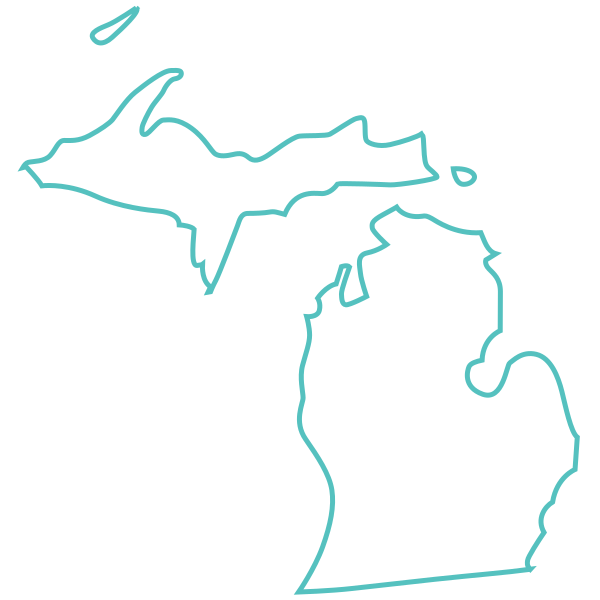
Parikh Financial runs the books, the returns and the back office for Michigan businesses, including white-labeled work delivered under your own brand. What changes from one state to the next is what you have to register for, collect and file — and that is the part we track.
Outsourced Services
Timely, accurate, compliant books so you can focus on running the business.
Explore →Stress-free preparation and filing for businesses across every industry.
Explore →AP, AR, payroll, and reporting handled end to end by our team.
Explore →Accurate cap tables and equity records as you raise and grow.
Explore →Scalable data pipelines that turn your numbers into decisions.
Explore →

Michigan levies a flat-rate personal income tax and a separate corporate income tax that applies only to C corporations, having retired its older, broader business taxes. The state has a single statewide sales and use tax rate with no local sales-tax add-ons, which makes Michigan unusually simple on the sales-tax side compared with most states. Lodging, however, is taxed through a patchwork of state use tax plus county and local assessment and convention taxes, which matters for hospitality operators.

And Accelerate Growth Across
Michigan
Michigan Business Tax Guide
Michigan imposes a flat-rate personal income tax on individual income rather than a graduated bracket system, so a business owner pays the same marginal rate regardless of how much pass-through income flows through. Owners of S corporations, partnerships, and LLCs generally report their distributive share of business income on their personal Michigan return, where it is taxed at that single flat rate. Michigan starts from federal adjusted gross income and then applies state-specific additions and subtractions, and many Michigan cities (Detroit, Grand Rapids, Lansing, and others) levy their own separate municipal income tax on residents and on income earned within the city, which is a distinct filing from the state return.
Michigan's Corporate Income Tax (CIT) applies a flat 6% to C corporations on apportioned business income, while pass-through entities are generally not taxed at the entity level under the CIT and instead push income out to owners. Two separate provisions take smaller corporations out of the CIT altogether, and MCL 206.685(1) sets them independently: a taxpayer whose apportioned or allocated gross receipts come to less than $350,000 need not file a return or pay the tax, and so need not a taxpayer whose CIT liability works out at $100 or less. Meeting either one is enough. The $350,000 is annualized for a tax year shorter than twelve months, a unitary group tests it after eliminating intercompany transactions, and a corporation holding an interest in a flow-through entity picks up its proportionate share of that entity's gross receipts when measuring its own position against the line. The gross receipts threshold does not reach insurance companies or financial institutions, though the $100 liability test still does. Above those lines the CIT carries exactly one credit, the small business alternative credit, which recomputes the tax at 1.8% of adjusted business income. It is lost outright if gross receipts exceed $20 million, if any shareholder or officer has allocated income above $180,000, or if adjusted business income after the loss adjustment exceeds a ceiling that is indexed each year to the Detroit consumer price index and stood at $1,795,300 for 2025. It tapers rather than disappears between $19 million and $20 million of gross receipts, and between $160,000 and $180,000 of shareholder or officer income. Michigan retired its older Single Business Tax and the later Michigan Business Tax, so most owner-operated businesses now deal only with the CIT (for C corps) and the flat personal income tax (for pass-throughs), without a general franchise or gross-receipts tax. Michigan also offers a flow-through entity (FTE) tax election that lets partnerships and S corporations elect to pay Michigan tax at the entity level, creating a federal SALT-cap workaround, with owners taking a corresponding credit on their personal returns; the election is made annually and should be evaluated against current Michigan Department of Treasury guidance.
Michigan has a single statewide sales and use tax administered by the Department of Treasury, and notably there are no county or city sales-tax add-ons, so the rate a customer pays is uniform across the state. The use tax mirrors the sales tax and captures taxable purchases (including many out-of-state and remote purchases) where sales tax was not collected at the point of sale. Remote sellers and marketplace facilitators that exceed Michigan's economic-nexus thresholds for sales or transaction count must register, collect, and remit; because Michigan is single-rate, the main compliance work for multi-state sellers is determining when nexus is triggered rather than tracking dozens of local jurisdictions.
Short-term lodging in Michigan is generally subject to the statewide use tax on the rental of rooms and accommodations, and on top of that many counties impose a county accommodations (hotel/motel) tax, while specific regions layer convention and tourism assessments such as those in the Detroit metro and other designated areas. A campground cabin or RV site rented as transient lodging, a hotel room, and a short-term rental can therefore each carry a combination of the state use tax and one or more local lodging levies, depending on the county and locality. Platforms like Airbnb and Vrbo may collect and remit some of these taxes for hosts, but coverage is inconsistent across the various county and assessment taxes, so operators should confirm exactly which levies apply at each property and what the platform actually remits versus what must be filed directly.
Businesses generally register with the Michigan Department of Treasury (commonly through Michigan Treasury Online) for sales, use, and withholding tax accounts, and form or qualify the entity separately with the Department of Licensing and Regulatory Affairs (LARA), which administers the annual report and statement filings for corporations and LLCs. Filing cadence varies by tax type and volume: sales, use, and withholding returns are typically filed on a periodic schedule tied to liability size with an annual reconciliation, while income and corporate taxes follow an annual return with estimated payments during the year. Because city income taxes, county lodging taxes, and the state accounts each run on their own channels, keeping clean entity-level records and a calendar of every account's cadence is the practical key to staying compliant.
Michigan's split personality is what trips up owners: sales tax is refreshingly simple and uniform statewide, but income and lodging taxes are highly localized. More than twenty Michigan cities impose their own municipal income tax with separate registration, withholding, and annual filings, so a business with employees or income in Detroit or Grand Rapids has city obligations entirely apart from the state. On the hospitality side, county accommodations taxes and regional convention or tourism assessments vary significantly from one county to the next, so an operator running properties in multiple Michigan counties faces different lodging-tax stacks at each location even though the state sales tax is identical everywhere.
Michigan businesses work with Parikh Financial to keep clean entity-level books across the state's flat income tax, C-corp CIT, optional flow-through entity election, and the many separate city income taxes that catch multi-location employers off guard. For STR, campground, and hotel operators especially, we map which county accommodations and regional convention taxes apply at each property and reconcile what booking platforms remit against what still has to be filed directly with the state and county.
Book a CallTax rules and rates change. General information for Michigan operators, not tax advice — confirm current requirements with the Michigan Department of Revenue or your Parikh Financial contact.