
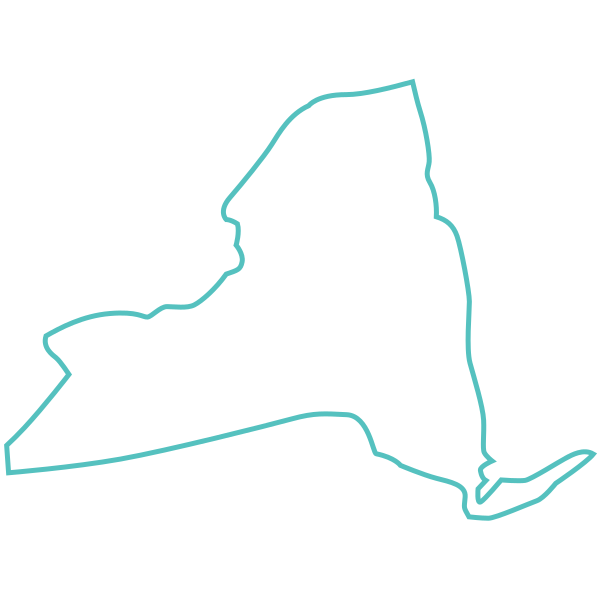
Parikh Financial runs the books, the returns and the back office for New York businesses, including white-labeled work delivered under your own brand. What changes from one state to the next is what you have to register for, collect and file — and that is the part we track.
Outsourced Services
Timely, accurate, compliant books so you can focus on running the business.
Explore →Stress-free preparation and filing for businesses across every industry.
Explore →AP, AR, payroll, and reporting handled end to end by our team.
Explore →Accurate cap tables and equity records as you raise and grow.
Explore →Scalable data pipelines that turn your numbers into decisions.
Explore →

New York levies a graduated personal income tax, a corporate franchise tax on businesses, and a statewide sales and use tax that is layered with substantial county and city rates. It is a high-tax, high-compliance state where many obligations differ inside New York City and the surrounding Metropolitan Commuter Transportation District, and where lodging and occupancy taxes are common across both the state and individual localities. The New York State Department of Taxation and Finance administers most state taxes, while New York City separately administers several of its own business taxes.

And Accelerate Growth Across
New York
New York Business Tax Guide
New York has a graduated personal income tax that applies to residents on all income and to nonresidents on New York-source income, so owners of sole proprietorships, partnerships, S corporations, and LLCs generally report their share of business profits on their individual New York returns. Pass-through income flows to owners on a Schedule K-1 and is taxed at the individual level, and New York City residents owe an additional city personal income tax on top of the state tax, which makes the city among the highest-taxed places in the country for owner income. New York also applies detailed residency and statutory-residency rules, so where an owner lives and how many days they spend in the state can materially change their personal tax exposure.
C corporations doing business in New York are subject to the state corporate franchise tax, which is computed under three bases — business income, business capital, and a fixed dollar minimum keyed to New York receipts — with the taxpayer paying the highest of the three rather than a single flat rate on profits. For a small operator the third base is usually the answer: the fixed dollar minimum starts at $25 where New York receipts are $100,000 or less and climbs in steps from there. The capital base is still live, at 0.1875% for general business taxpayers and capped at $5 million of tax, but it is 0% for qualified New York manufacturers, qualified emerging technology companies, cooperative housing corporations and small business taxpayers, so a company that meets the small-business test computes that base at nothing and pays on income or the minimum instead. New York City imposes its own General Corporation Tax and Unincorporated Business Tax, so a business operating in the city can face city-level taxes in addition to the state franchise tax. New York also offers an elective Pass-Through Entity Tax (PTET), and New York City has its own PTET, allowing eligible partnerships and S corporations to pay tax at the entity level as a workaround to the federal SALT deduction cap; because these regimes and their interactions are complex, the right structure and elections should be confirmed against current Department of Taxation and Finance guidance.
New York imposes a statewide sales and use tax, and counties and cities add their own local rates on top, so the combined rate a business charges varies meaningfully by location, with New York City carrying one of the higher combined rates in the state. Certain categories are treated differently, including exemptions or reduced treatment for some clothing and footwear and for many grocery food items, which makes correct product taxability as important as the rate itself. Remote sellers and marketplace facilitators that exceed New York's economic-nexus thresholds for sales and transactions must register, collect, and remit even without physical presence in the state, and businesses with offices, inventory, or employees in New York generally must register and collect for each jurisdiction where they have nexus.
Short-term lodging in New York is subject to state and local sales tax on the room charge, and many counties and cities also impose a separate hotel or room occupancy tax on stays under a defined length, which means a campground, RV park, hotel, or short-term-rental host can owe several overlapping taxes on a single booking. New York City layers on its own Hotel Room Occupancy Tax in addition to state and city sales tax, and other tourism-heavy areas around the state administer their own occupancy taxes at the county level. Hosts who rent through online marketplaces should not assume the platform remits every applicable tax, because marketplace collection often covers state sales tax but may not capture every local occupancy tax, leaving the operator responsible for registering and filing the remainder.
Most New York businesses register with the Department of Taxation and Finance, typically obtaining a Certificate of Authority before making taxable sales and setting up sales, withholding, and corporate or PTET accounts through the state's Online Services system. Sales and use tax is filed on a recurring cadence (annual, quarterly, or part-quarterly) that the state assigns based on tax volume, while corporate franchise, personal income, and PTET filings follow their own annual cycles with estimated payments along the way. Operators should keep detailed records of gross receipts, exempt and resale sales with valid exemption certificates, jurisdiction-level tax collected, and occupancy-tax remittances, since New York is an active audit state and jurisdiction-by-jurisdiction documentation is the most common exposure for multi-location and hospitality businesses.
New York's biggest planning complication is the split between state taxes and the separate, additional taxes administered by New York City, so the same business can face state franchise tax plus city General Corporation Tax or Unincorporated Business Tax, and an owner can face both state and city personal income tax. The Metropolitan Commuter Transportation District surcharge and mobility tax add further obligations for businesses and employers operating in the downstate region around New York City. For campground, RV-park, and short-term-rental operators upstate and in destination areas like the Adirondacks, the Catskills, and Long Island, county-level occupancy taxes and aggressive residency and nexus rules make local registration and same-jurisdiction filing the details most often missed.
Parikh Financial keeps New York owner-operators compliant across the state's high-rate sales, use, and occupancy-tax jurisdictions while tracking economic nexus and the separate New York City and MCTD obligations as they grow. For STR, campground, and hospitality clients especially, we handle Certificate of Authority registration, jurisdiction-level occupancy-tax remittance, and the entity-structure and PTET-election decisions that determine how much New York and New York City tax owners actually pay.
Book a CallTax rules and rates change. General information for New York operators, not tax advice — confirm current requirements with the New York Department of Revenue or your Parikh Financial contact.