
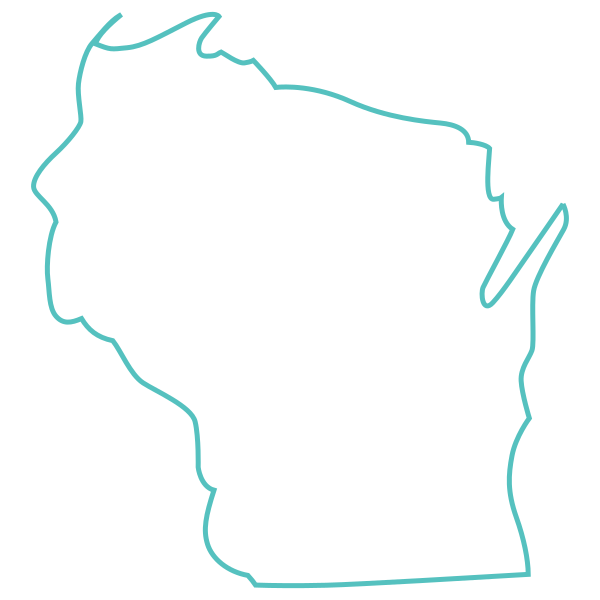
Parikh Financial runs the books, the returns and the back office for Wisconsin businesses, including white-labeled work delivered under your own brand. What changes from one state to the next is what you have to register for, collect and file — and that is the part we track.
Outsourced Services
Timely, accurate, compliant books so you can focus on running the business.
Explore →Stress-free preparation and filing for businesses across every industry.
Explore →AP, AR, payroll, and reporting handled end to end by our team.
Explore →Accurate cap tables and equity records as you raise and grow.
Explore →Scalable data pipelines that turn your numbers into decisions.
Explore →

Wisconsin levies a graduated personal income tax and a separate corporate income and franchise tax on C corporations. It imposes a statewide sales and use tax on top of which most counties add a local sales tax, and it administers lodging through a state-authorized local room tax that municipalities, not the state, impose and collect. Pass-through owners can elect to be taxed at the entity level as a federal SALT-cap workaround.

And Accelerate Growth Across
Wisconsin
Wisconsin Business Tax Guide
Wisconsin taxes individual income using several graduated brackets, so owners with substantial flow-through income move into higher marginal rates as income rises. Income from S corporations, partnerships, and LLCs generally passes through to the owners and is reported on their Wisconsin individual returns rather than taxed at the entity level by default. Wisconsin starts from federal adjusted gross income and applies its own additions, subtractions, and credits, so the Wisconsin result does not simply mirror the federal number. Confirm current brackets, the standard deduction phase-out, and conformity items with the Wisconsin Department of Revenue, since the legislature periodically adjusts them.
Wisconsin runs a corporate franchise tax and a corporate income tax as two separate levies, and only one of them reaches any given corporation in a year. Which one is not a choice. The franchise tax covers every corporation organized under Wisconsin law and every out-of-state corporation actually doing business here; the income tax reaches only an out-of-state corporation that escapes the franchise tax and either owns Wisconsin property or does business here exclusively in interstate or foreign commerce. Put plainly, any intrastate business puts you in the franchise tax and purely interstate business puts you in the income tax. Both run at 7.9% on income apportioned to the state, generally on a single sales factor, so the rate is not what separates them. The base is: income from United States government obligations counts under the franchise tax and does not count under the income tax, which means a corporation holding Treasuries can owe more on the franchise side at an identical rate. Wisconsin does not impose a broad gross-receipts tax like Ohio or Washington, but it does add an economic development surcharge on top of whichever tax applies. That surcharge reaches any corporation, tax-option S corporation, insurer or taxable exempt organization with $4 million or more of gross receipts from all activities, and gross receipts here is a wide measure taking in sales, dividends, interest, rents, royalties, the gross price of disposed assets and receipts passed through from other entities. A C corporation pays the greater of $25 or 3% of its gross tax liability; a tax-option S corporation pays the greater of $25 or 0.2% of its Wisconsin net income; either way the ceiling is $9,800. The $25 floor is the part that surprises people, because it is owed even where the gross tax is zero, so a loss-making company over the receipts line still writes a cheque. Two further traps: the floor and the ceiling are not prorated for a short period and each short period counts as its own taxable year, so a corporation changing its year end can meet the maximum twice inside one calendar year; and in a combined group the surcharge is worked out member by member against each member's own receipts and own gross tax, with nexus for one member giving nexus to all. Wisconsin offers a pass-through entity (PTE) tax election that lets partnerships and tax-option S corporations pay the state tax at the entity level, which can preserve a federal deduction for owners working around the SALT cap. Because the election interacts with owner residency, credits, and out-of-state filings, it should be modeled each year rather than treated as a standing default.
Wisconsin imposes a statewide sales and use tax, and most counties layer a local county sales tax on top, so the combined rate depends on the county where the sale is sourced. Certain districts have historically carried additional special local taxes (such as stadium or premier-resort area taxes in specific jurisdictions), which means the rate is not uniform statewide. Use tax applies when taxable goods or equipment are bought without Wisconsin tax and then used in the state, a rule that routinely catches out-of-state and online purchases by businesses. Sellers should source each sale to the correct county rather than relying on a single statewide figure.
Following the Wayfair decision, Wisconsin requires out-of-state sellers that exceed a sales threshold into the state to register, collect, and remit Wisconsin sales tax even without physical presence; Wisconsin removed its separate transaction-count test, so the dollar volume of sales is the relevant trigger. Marketplace providers are generally responsible for collecting and remitting tax on the third-party sales they facilitate, shifting much of that burden off individual sellers for those channels. A seller's own direct sales outside any marketplace still create independent registration and filing duties. Confirm the current threshold and provider rules with the Department of Revenue before relying on a specific figure, as these have been adjusted since the original rollout.
Wisconsin does not run a single statewide lodging tax; instead state law authorizes municipalities (cities, villages, and towns) to impose a local room tax on short-term lodging, so the rate and rules vary by where the property sits. Furnishing rooms or lodging is also generally subject to state and county sales tax, meaning STR hosts, campground and RV-park operators, and hotels typically face a stacked bill of sales tax plus a municipal room tax that is administered and remitted locally, often to the municipality or a tourism commission rather than the state. A share of room tax collections is commonly required to fund tourism promotion through a local tourism entity. Booking platforms collect some of these taxes for hosts, but coverage is inconsistent and frequently excludes the municipal room tax, leaving operators to register and file directly with the municipality where each property operates.
Businesses generally register with the Wisconsin Department of Revenue for a seller's permit and for income tax withholding, and separately with each municipality that imposes a room tax where a lodging property operates. Wisconsin assigns a sales tax filing frequency (monthly, quarterly, or annually) based on tax volume, so a growing operator's cadence can change over time, while municipal room tax filings follow each municipality's own schedule. Corporate and individual returns track the federal calendar on Wisconsin-specific forms, and many businesses make estimated payments through the year. Keep clean exemption certificates, county-level sales detail, and per-property room tax records, because Wisconsin's county sales taxes and locally administered room taxes make audits turn on whether tax was collected and remitted to the right jurisdiction.
Wisconsin's graduated rates, single-sales-factor corporate apportionment, county sales-tax add-ons, and patchwork of locally administered room taxes make compliance genuinely error-prone for owner-operated and multi-location hospitality businesses. Parikh Financial handles the bookkeeping, multi-state and multi-jurisdiction nexus tracking, municipal room-tax registration and remittance, and PTE-election modeling so Wisconsin operators stay compliant without building that machinery in-house.
Book a CallTax rules and rates change. General information for Wisconsin operators, not tax advice — confirm current requirements with the Wisconsin Department of Revenue or your Parikh Financial contact.