
Solar Tax Credits for High Earners: What Survived 2025, and Who Can Actually Use Them
The 30% credit on your own home ended December 31, 2025. The business credit survived, on a deadline. A Treasury regulation decides whether either one touches your tax bill, and for most high-W-2 earners the answer is no.
If someone is pitching you solar as a tax play, the size of the credit is the wrong first question. The right one is whether you have the kind of income the credit is allowed to offset. For a high earner whose income is mostly W-2 wages, the answer is usually no, and that tends to be the last thing raised in the sales conversation.
The rule that decides it is Section 469 of the Internal Revenue Code, the passive activity rules. It has been on the books since 1986. It is not a loophole anyone is closing. It is the reason a lot of solar tax deals do nothing for the person who funds them.
Here is what the law says as of September 2026.
1The credit on your own home is gone
The One Big Beautiful Bill Act, enacted July 4, 2025, ended the §25D Residential Clean Energy Credit. Section 70506 of the Act struck the old 2034 expiration and replaced it with termination “with respect to any expenditures made after December 31, 2025.”
The test is expenditures made, not placed in service, but §25D(e)(8) makes the two converge: an expenditure is treated as made when the original installation is completed. The IRS addressed the obvious question directly in its OBBBA energy credit FAQ. Paying in 2025 for a 2026 installation does not preserve the credit:
“If installation is completed after December 31, 2025, the expenditure will be treated as made after December 31, 2025, which will prevent the taxpayer from claiming the section 25D credit.”
IRS FAQ FS-2025-05, Q7The §25C Energy Efficient Home Improvement Credit, which covered heat pumps, windows and insulation, ended on the same date under §70505, on a placed-in-service test.
Plenty of published advice still describes both credits as current. If your advisor is modeling 30% on your primary residence, they are working from a statute that changed fourteen months ago.
One correction worth making, because it is the most widely misreported piece of the bill: OBBBA did not restrict residential rooftop solar leasing or third-party ownership. The new §48E(i) leasing denial cross-references only §25D(d)(1) and §25D(d)(4), which are solar water heating and small wind. Photovoltaic property sits in §25D(d)(2) and was dropped from the enacted version. Several law firm alerts still analyzing the May 2025 House draft say otherwise.
2The business credit survived, with two dates that matter
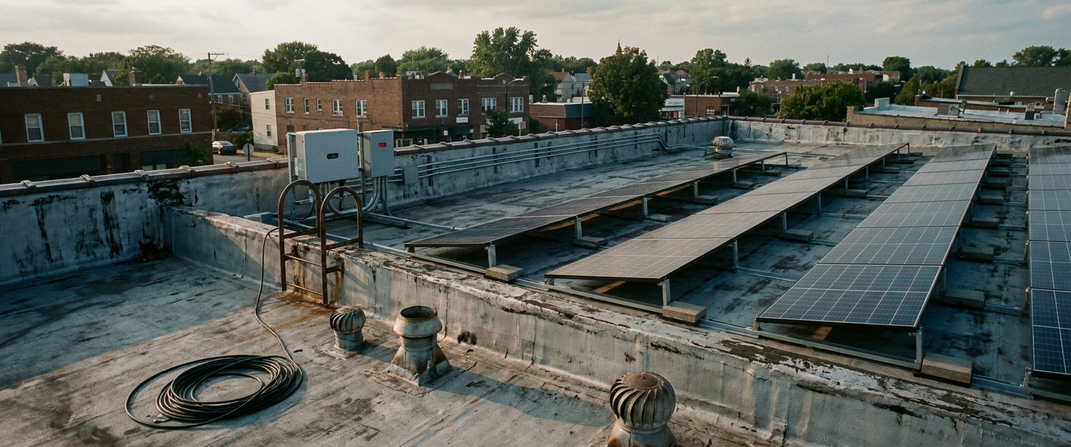
Solar on property you hold to produce income still qualifies for the §48E Clean Electricity Investment Credit. A rental house, a commercial building, a campground bathhouse, the office your operating company works from.
OBBBA §70513 added §48E(e)(4), which terminates the credit for wind and solar property placed in service after December 31, 2027. The effective date provision, §70513(g)(5), limits that termination to facilities whose construction begins after July 4, 2026.
Two alternative gates, not cumulative:
- Construction began on or before July 4, 2026 — the 2027 termination never applies, and you fall back to the ordinary four-year continuity rules.
- Construction begins after July 4, 2026 — placed in service by December 31, 2027 or there is no credit.
Miss both and you get nothing. Co-located battery storage is carved out of the termination by §48E(e)(4)(C), which is worth knowing if storage is part of the project.
One live wrinkle on begin-construction. IRS Notice 2025-42 had eliminated the 5% cost safe harbor for wind and large solar, leaving only the physical work test. On June 6, 2026, the District Court for the District of Columbia vacated that notice in full as arbitrary and capricious in Oregon Environmental Council v. IRS. The 5% safe harbor is currently restored. Firms across the board expect an appeal, and a reversal could operate retroactively. If a sponsor is telling you their project banked begin-construction status through a 5% spend, that position depends on a district court opinion that may not survive. Ask when the spend happened and what the fallback is.
3The three ways this reaches you
Direct ownership. You install solar on income-producing property you own, claim the credit on Form 3468, and carry it to Form 3800.
A tax-equity partnership. A project allocates you a share of its credit and depreciation on a K-1.
Buying someone else’s credit. Under §6418, a project owner can sell its credit to an unrelated buyer for cash, typically below face value. The seller’s cash is tax-free to them; the buyer claims the credit. OBBBA left transferability intact, adding only a prohibition on sales to specified foreign entities.
The first is an investment in an asset. The third is closer to buying a discounted tax payment. They get described with the same vocabulary and they are not the same thing.
4The rule that stops most people
For an individual, the solar credit is a passive activity credit.
§469(a)(1)(B) disallows passive activity credits for individuals. §469(d)(2) defines the term as the excess of credits from passive activities over “the regular tax liability of the taxpayer for the taxable year allocable to all passive activities.”
If you have no net passive income, the tax allocable to passive activities is zero, and the entire credit is disallowed. It suspends and carries forward under §469(b) until passive income shows up.
Taxpayers have tried to argue their way out of this on the theory that §48 lives in a different subpart of the Code than §38. The Tax Court rejected it in Strieby v. Commissioner, T.C. Memo. 2025-28, decided April 3, 2025:
“Section 48 sets forth rules for determining the energy credit, but, contrary to Petitioners’ argument, does not itself allow any credit. Rather, the amount determined under section 48 and included in the amounts under section 46, and thus section 38, is allowable only under that subpart… and, accordingly, potentially, a passive activity credit.”
Strieby v. Commissioner, T.C. Memo. 2025-28The court sustained §6662 negligence penalties on the entire underpayment. The taxpayer in Strieby had invested in an Arizona entity called Solar Farm, LLC. Its promoter, Charles Kirkland, was sentenced in 2023 to nine years and $51.6 million in restitution for claiming more than $135 million in fabricated solar losses against under $6 million actually spent.
5Buying a credit does not get you around it
This is the part most pitches skip, and it is written into a Treasury regulation rather than left to argument.
Reg. §1.6418-2(f)(3), issued in T.D. 9993 (April 2024), addresses purchased credits directly:
“A specified credit portion transferred to a transferee taxpayer is treated as determined in connection with the conduct of a trade or business and, if applicable, such transferred specified credit portion is subject to the rules in section 469. In applying section 469, unless a transferee taxpayer owns an interest in the eligible taxpayer’s trade or business at the time the work was done, the fact that the specified credit portion is treated as determined in connection with the conduct of a trade or business does not cause the transferee taxpayer to be considered to own an interest in the eligible taxpayer’s trade or business at the time the work was done and does not change the characterization of the transferee taxpayer’s participation (or lack thereof)…”
Reg. §1.6418-2(f)(3)The regulation deems the purchased credit to arise from a trade or business, then denies the buyer both the ownership predicate and the grouping rules that would let them treat it as non-passive.
So a surgeon earning $1.5 million on a W-2 who buys $300,000 of solar credits at a discount has bought a passive activity credit. It does not reach wage income, business income from a practice they run, or portfolio income. It sits suspended, waiting for passive income that may never arrive in the size needed.
If someone selling you transferred credits has not raised §1.6418-2(f)(3), they either do not know it exists or are not telling you. Either way, that is the question to put in writing before you wire anything.
6The $25,000 rental allowance does not help
§469(i) allows up to $25,000 of passive losses and credit equivalents against other income for actively participating taxpayers, phased out between $100,000 and $150,000 of AGI. Two reasons it is not the answer.
First, the phase-out. At any income level where solar credits are being marketed to you, the allowance is fully phased out. The higher $200,000 to $250,000 range in §469(i)(3)(B) applies only to the rehabilitation credit.
Second, and more fundamental: §469(i) reaches only rental real estate activities. Solar equipment is generally §1245 tangible personal property, not real property. The Tax Court disposed of the argument in one line in Kelly v. Commissioner, T.C. Memo. 2000-32: “But that section applies only to ‘rental real estate activities.’”
You can see this on the form itself. On Form 8582-CR, solar credits land in Part I lines 4a through 4c, “All Other Passive Activity Credits.” Every other bucket on that form feeds a special-allowance Part. Line 4c feeds only line 5. There is no Part for it.
7The math on a $100,000 install
Assume $100,000 of solar on a rental property qualifying at 30%.
- Credit: $30,000
- Basis reduction under §50(c)(3), equal to 50% of the credit: $15,000
- Depreciable basis: $85,000
- Solar under §48E remains 5-year MACRS property, and OBBBA §70301 made 100% bonus depreciation permanent for property acquired and placed in service after January 19, 2025, so the full $85,000 is deductible in year one
A $100,000 spend produces a $30,000 credit plus an $85,000 first-year deduction. The arithmetic is real, and it is what the sales deck shows you.
What the deck does not show is that if the activity is passive, §469 suspends both numbers. And the credit and the deduction do not behave the same way on the way out, which brings us to the trap that costs the most money.
8Suspended losses come back. Suspended credits do not.
When you dispose of your entire interest in a passive activity in a fully taxable sale to an unrelated party, §469(g) releases your suspended losses. It says nothing about credits. The word “credit” appears nowhere in §469(g), while §469(b) expressly covers “any loss or credit.” The omission is deliberate.
IRS Publication 925 states it plainly, and the Form 8582-CR instructions are blunter:
“Unallowed PACs, unlike unallowed passive activity losses, aren’t allowed when you dispose of your interest in an activity.”
Instructions for Form 8582-CRThere is a partial consolation in §469(j)(9). On a qualifying disposition you may elect to add back to basis the amount by which the credit reduced basis in the first place. Because §50(c)(3) reduces basis by only 50% of the credit, the election can restore at most half the credit, and electing it forfeits the credit permanently. Novogradac’s assessment is that the election “is less valuable than taking the credit.” It is a way to salvage something, not a plan.
9Pros and cons
10Pitfalls and misconceptions
“It’s a 30% credit.” For projects of 1 MW AC and above, 30% is the ceiling. The base rate is 6%, and you reach 30% by satisfying prevailing wage and apprenticeship requirements during construction and for five years of alterations and repairs. Projects under 1 MW are deemed to satisfy them. A rooftop array is fine. A larger ground-mount is a construction-contract compliance problem, and failing it cuts the credit by 80%. Compliance now gets reported on the new Form 7220.
“I can use it against my W-2.” Covered above. This is the one that costs real money, and it applies to purchased credits too.
“My house counts.” Not for installations completed after December 31, 2025.
“My rental counts, so §25D works.” It never did. The IRS could not be more direct in FS-2025-01: “The credit is never available for homes not used as a residence by the taxpayer. For example, landlords can never use the credit for homes they rent out but do not use as a residence themselves.” A rental is a §48E question, not a §25D question.
“I depreciate the full $100,000.” You depreciate $85,000. Overstating this compounds across the whole schedule.
“I can sell whenever I want.” §50(a) recaptures the unvested credit if you dispose of the property or stop qualifying use within five years, vesting 20% per year.
“Nonrecourse financing is fine.” §49(a)(1) reduces your credit base by nonqualified nonrecourse financing, and a note back to the seller or developer fails the “qualified commercial financing” test three separate ways under §49(a)(1)(D): the lender is the person you acquired the property from, is often a related party, and typically receives a fee tied to your investment. A put option or price-support backstop also converts recourse debt to nonrecourse for this purpose. Cooper v. Commissioner, 88 T.C. 84 (1987), a solar water heater case, is still the cleanest authority on that point.
And the asymmetry underneath it. §465(b)(6) treats you as at risk for qualified nonrecourse financing only for activities of holding real property, secured by real property. Solar equipment is not real property. So nonrecourse debt can support up to 80% of your §49 credit base while giving you zero at-risk basis for the depreciation. You can qualify for the full credit and be unable to deduct most of the loss.
“I’ll materially participate to make it non-passive.” If the arrangement is a rental activity, material participation is irrelevant. §469(c)(2) makes rental activities passive and §469(c)(4) applies that “without regard to whether or not the taxpayer materially participates.” The regulation is deliberately label-blind, reaching amounts paid “principally for the use of such tangible property (without regard to whether the use of the property by customers is pursuant to a lease or pursuant to a service contract or other arrangement that is not denominated a lease).” Novogradac’s operating rule is worth memorizing: rooftop solar rental is always passive no matter how many hours you log, so the project has to earn revenue from selling electricity rather than renting equipment.
“The bonus adders are easy.” Energy community and domestic content each add 10 percentage points. Domestic content requires 100% US iron and steel plus a manufactured-products threshold, documented with supplier certifications. Claiming it without them is unsupported, not aggressive.
“The installer’s tax letter is my substantiation.” It is marketing. Placed in service means permitted, interconnected, tested and ready for operation. Mechanical completion moves the credit to a different year.
New for 2026: the foreign-entity rules. For projects beginning construction after December 31, 2025, §48E and §45Y now require a minimum “material assistance cost ratio” measuring the share of direct costs not traceable to a prohibited foreign entity. For qualified facilities the threshold is 40% for 2026, rising to 60% after 2029. Notice 2026-15 provides 95 pages of interim guidance and three safe harbors. Note the penalty: the §6662 substantial-understatement threshold drops from 10% to 1% for a disallowance attributable to overstating that ratio. If a 2026 project cannot document its ratio, that is a walk-away.
11So who can actually use this?
Three profiles, and only three.
You have real net passive income. A rental portfolio producing taxable income, K-1 income from operating businesses you do not run, other passive activities generating tax to offset. The credit converts to cash against that tax. This is the honest fit.
You own solar inside a business you materially participate in, and the revenue comes from selling electricity rather than renting equipment. Then the activity is non-passive, the credit offsets active income, and the analysis changes completely. Narrow, and it requires the project to be structured that way from the start, not relabeled afterward.
You are a widely held C corporation. §469 does not apply to you and neither does §49. This is why institutional tax equity exists and why the best-priced credits never reach individual buyers.
If none of those describe you, a solar tax credit is a carryforward, not a deduction. It may still be a fine investment on the energy economics. It is not a way to lower this year’s tax bill.
12How risky is this from an audit standpoint?
Worth separating what is actually known from what gets asserted.
There is no published audit rate for energy credit claims. Not for Form 3468, not for Form 5695, not for Form 3800, not for §6418 transfers. The IRS Data Book breaks out examination coverage by return type and income band, not by credit claimed. Anyone quoting you an audit percentage for solar credits is making it up. TIGTA’s July 2026 improper payment assessment goes the other way: Treasury risk-assessed the elective pay and transferability program for FY2025 and rated it “not susceptible” to significant improper payments.
The formal enforcement infrastructure is thin. No solar or clean energy entry has appeared on the IRS Dirty Dozen in any year from 2023 through 2026. There is no LB&I compliance campaign on energy credits or transferability. No solar arrangement is a listed transaction or a transaction of interest. IRS Criminal Investigation’s FY2024 and FY2025 annual reports do not contain the word “solar” once.
What does exist is more specific than a campaign. Treasury wrote the §469 answer into a regulation, which means an individual buyer has no argument left to make. Strieby is a decided case with negligence penalties attached. §6418(g)(2) imposes an excessive-credit-transfer tax equal to the excess plus 20%. And the anti-abuse rule in Reg. §1.6418-2(e)(4) triggers on “a principal purpose,” not “the principal purpose,” which is a materially lower bar than most taxpayers assume.
Detection is structurally easy here, which is the part to understand. §6418(g)(1) conditions a transfer election on pre-filing registration. The IRS issues a registration number per property per taxable year, and that number has to appear on both the seller’s and the buyer’s returns. That is a government-issued matching key on two independent filings. A partnership credit arrives via K-1 the same way. This is not a Schedule E deduction the IRS has to go looking for.
Promoter enforcement has been real, just concentrated. The 2018 RaPower-3 case produced a $50 million disgorgement order, affirmed by the Tenth Circuit, against promoters the court found “knew, or had reason to know, that their statements about the tax benefits… were false or fraudulent.” Since 2024 the Justice Department has brought at least six civil injunction suits against return preparers fabricating residential energy credits, with permanent injunctions entered against preparers in Florida and Illinois. In August 2026 a Birmingham preparer was indicted on 33 counts for returns claiming false geothermal property costs, with more than $70 million in refunds claimed and $65 million paid out. Those are allegations at this stage.
13What to do before you write a check
- Compute your net passive income. Not your total income. The tax on your passive activities is the ceiling on what a solar credit can do for you this year.
- Ask in writing how the seller reconciles their pitch with Reg. §1.6418-2(f)(3) if you are buying a transferred credit.
- Get the begin-construction date with documentation, and ask whether it rests on the physical work test or a 5% spend. If it is the 5% spend, ask what happens on appeal.
- Ask which adder supports any rate above 30%, and request the supplier certifications or energy community determination.
- Model the §50(c)(3) basis reduction before modeling depreciation, and check §465 at-risk basis separately from the §49 credit base. They give different answers.
- Confirm the five-year recapture window against your actual expected hold period.
Whether the credit is usable depends on your tax liability this year and on whether the passive activity rules limit it, and that is worth knowing before you commit. If you are evaluating a solar deal now, our tax planning team can model what it would do to your return. Book a call with the offering documents and last year's return.
Frequently asked
Questions, answered
Can I still get a tax credit for solar panels on my own home?
No. The §25D Residential Clean Energy Credit terminated for expenditures made after December 31, 2025 under OBBBA §70506, and §25D(e)(8) treats the expenditure as made when installation is completed. Per the IRS FAQ, paying in 2025 for a 2026 installation does not preserve the credit. Property you hold to produce income is a separate question under §48E.
I earn $2 million a year on a W-2. Will buying solar tax credits lower my tax bill?
Almost certainly not. Reg. §1.6418-2(f)(3) makes a purchased §6418 credit subject to §469 in the buyer's hands and denies the buyer both the ownership predicate and the grouping rules that would make it non-passive. Under §469(a)(1)(B) the credit is disallowed to the extent it exceeds your tax allocable to passive activities. With no passive income, that is the entire credit. It suspends under §469(b) and waits.
What happens to a credit I can't use this year?
It carries forward indefinitely under §469(b) until you have passive income to absorb it. It does not enter the general business credit pool while suspended, so the §39 one-year carryback is unavailable. And unlike suspended passive losses, suspended passive credits are not released when you dispose of the activity. §469(j)(9) lets you elect to restore the basis reduction instead, capped at 50% of the credit because that is all §50(c)(3) took, and electing it forfeits the credit permanently.
Does solar on my short-term rental qualify?
It is a §48E question rather than §25D, since §25D never reached property you do not live in. §50(b)(2) generally denies the investment credit for property used to furnish lodging, but §50(b)(2)(D) excepts energy property, and §50(b)(2)(B) separately excepts lodging where the predominant portion of accommodations is used by transients. Both routes are likely available to a genuine STR. Worth flagging honestly: no IRS guidance squarely holds that §50(b)(2)(D) covers §48E qualified property specifically, so a large installation on a pure-lodging asset deserves a written position before you rely on it.
Is solar still worth it without a usable credit?
That becomes an energy question rather than a tax question. Installed cost against your utility rate, rate escalation, and hold period. It can pencil on its own merits. It does not pencil the way a 30% credit made it pencil, and the depreciation may be limited too if your at-risk basis is thin.