
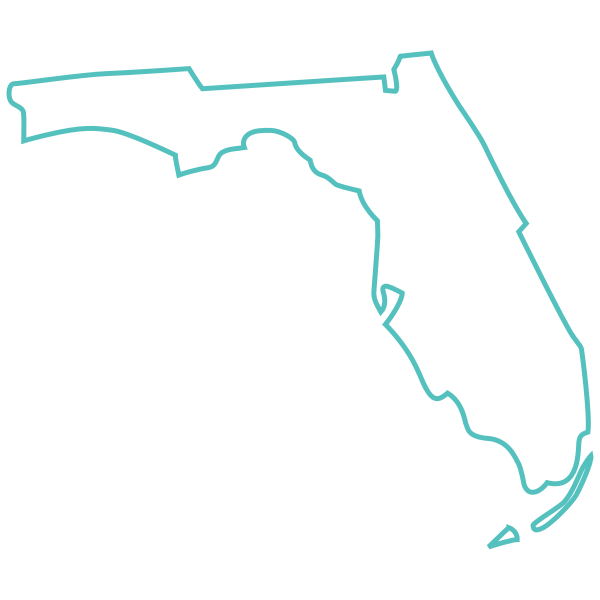
Parikh Financial proudly supports Florida businesses with tailored, white-labeled financial services. From startups to established companies, we streamline finances, optimize taxes, and drive growth with expert bookkeeping, tax prep, and outsourced accounting.
Outsourced Services
Timely, accurate, compliant books so you can focus on running the business.
Explore →Stress-free preparation and filing for businesses across every industry.
Explore →AP, AR, payroll, and reporting handled end to end by our team.
Explore →Accurate cap tables and equity records as you raise and grow.
Explore →Scalable data pipelines that turn your numbers into decisions.
Explore →

Florida is one of a small number of states with no personal income tax, which shapes how owner-operated businesses, investors, and pass-through entities are taxed at the state level. The state does levy a corporate income tax on traditional C corporations, a broad statewide sales and use tax administered by the Florida Department of Revenue, and layered lodging taxes that matter heavily to anyone renting accommodations. There is no statewide property tax, but counties impose property taxes and local-option surtaxes that vary significantly across Florida's 67 counties.

And Accelerate Growth Across
Florida
Florida Business Tax Guide
Florida is one of a small number of states with no personal income tax, which shapes how owner-operated businesses, investors, and pass-through entities are taxed at the state level. The state does levy a corporate income tax on traditional C corporations, a broad statewide sales and use tax administered by the Florida Department of Revenue, and layered lodging taxes that matter heavily to anyone renting accommodations. There is no statewide property tax, but counties impose property taxes and local-option surtaxes that vary significantly across Florida's 67 counties.
Florida does not impose a personal income tax, and this is written into the state constitution rather than being a temporary policy. For owners of pass-through entities such as S corporations, partnerships, and most LLCs, the business income that flows through to the owner is not subject to any Florida state income tax at the individual level. This is a durable, well-established feature of Florida and a major reason operators and investors domicile here, though that income is still subject to federal tax and you should confirm your filing posture for any other states where you operate.
Florida levies a corporate income tax on traditional C corporations and on entities taxed as corporations for federal purposes, generally building off federal taxable income with Florida-specific additions and subtractions. Because Florida has no personal income tax, it has no pass-through entity (PTE) tax election of the kind some states adopted as a federal SALT-cap workaround, and S corporations and partnerships generally do not pay an entity-level Florida income tax. Florida also does not impose a separate statewide franchise or privilege tax tied to net worth the way some states do, so entity-level state tax exposure usually centers on whether your business is taxed as a C corporation and on sales and use tax obligations.
Florida imposes a statewide sales and use tax on most retail sales of goods and many services, administered by the Florida Department of Revenue, and individual counties may add a discretionary sales surtax on top of the state rate. This means the effective rate a customer pays depends on the county where the sale is sourced, so businesses operating in multiple Florida counties must track local surtaxes carefully. Florida also enforces economic-nexus rules: remote sellers and marketplace facilitators that exceed the state's sales threshold into Florida must register, collect, and remit Florida sales tax even without a physical presence in the state.
Short-term rentals, campgrounds, RV parks, and hotels in Florida face a multi-layer lodging tax structure on stays below the state's defined duration threshold. At the state level, transient rental charges are subject to state sales tax plus any applicable county discretionary surtax, and on top of that most counties impose a local tourist development tax (often called a bed tax or resort tax) on the same short-term stays. Depending on the county, the tourist development tax is remitted either to the Florida Department of Revenue or directly to a county tax collector, and platforms like Airbnb or Vrbo may collect some but not necessarily all of these taxes, so operators must verify exactly which taxes they remain responsible for registering and remitting.
Businesses with Florida sales, use, or lodging tax obligations must register with the Florida Department of Revenue to obtain a sales tax certificate, and short-term rental operators often need an additional county-level account where tourist development tax is collected locally. Sales and use tax returns are filed on a recurring basis, with the required frequency generally driven by your tax volume, and Florida applies collection allowances and penalties that reward timely electronic filing. Maintain clean records of taxable versus exempt sales, resale and exemption certificates, county-by-county sourcing, and lodging stays by jurisdiction, since Florida audits sales and tourist development tax compliance and the burden of proof for exemptions falls on the seller.
Florida is heavily tourism-driven, so lodging and tourist development tax compliance is an outsized concern for STR, campground, and hotel operators, and county tourist development taxes can vary meaningfully from one county to the next. Florida also imposes commercial rent considerations and documentary stamp taxes on certain real-estate and financing transactions, which matter to real-estate investors closing deals or refinancing in the state. Because rules and which authority collects a given lodging tax differ by county, operators with properties in multiple Florida counties should confirm current Florida Department of Revenue and county tax collector guidance rather than assuming uniform treatment statewide.
Parikh Financial works with Florida owner-operators, STR and campground operators, hospitality businesses, and real-estate investors to keep clean books, register correctly for state sales and county-level lodging taxes, and stay on top of economic-nexus obligations as they grow across counties and states. We handle the multi-jurisdiction lodging-tax remittance and recordkeeping that Florida's layered tourist development tax structure demands, so you can confirm exactly which taxes you owe and which platforms are already collecting on your behalf.
Book a CallTax rules and rates change. General information for Florida operators, not tax advice — confirm current requirements with the Florida Department of Revenue or your Parikh Financial advisor.