
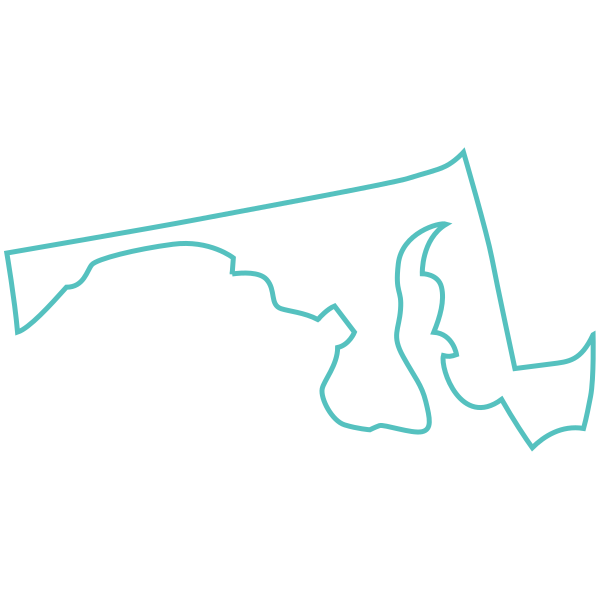
Parikh Financial proudly supports Maryland businesses with tailored, white-labeled financial services. From startups to established companies, we streamline finances, optimize taxes, and drive growth with expert bookkeeping, tax prep, and outsourced accounting.
Outsourced Services
Timely, accurate, compliant books so you can focus on running the business.
Explore →Stress-free preparation and filing for businesses across every industry.
Explore →AP, AR, payroll, and reporting handled end to end by our team.
Explore →Accurate cap tables and equity records as you raise and grow.
Explore →Scalable data pipelines that turn your numbers into decisions.
Explore →

Maryland levies a graduated state personal income tax and, distinctively, requires every Maryland county (and Baltimore City) to impose a local income tax that is collected on the same return as the state tax, so residents face a combined state-plus-local rate. The state also imposes a flat corporate income tax on C corporations, a statewide sales and use tax with no add-on local sales taxes, and a separate set of state and local lodging taxes that reach hotels, short-term rentals, and campgrounds. Most business tax accounts run through the Comptroller of Maryland, while entity formation and the annual report run through the State Department of Assessments and Taxation (SDAT).

And Accelerate Growth Across
Maryland
Maryland Business Tax Guide
Maryland levies a graduated state personal income tax and, distinctively, requires every Maryland county (and Baltimore City) to impose a local income tax that is collected on the same return as the state tax, so residents face a combined state-plus-local rate. The state also imposes a flat corporate income tax on C corporations, a statewide sales and use tax with no add-on local sales taxes, and a separate set of state and local lodging taxes that reach hotels, short-term rentals, and campgrounds. Most business tax accounts run through the Comptroller of Maryland, while entity formation and the annual report run through the State Department of Assessments and Taxation (SDAT).
Maryland has a graduated personal income tax with multiple brackets, and on top of the state tax every county and Baltimore City levies a mandatory local income tax that is calculated on the same Maryland return based on where the taxpayer lives. For owners of pass-through entities such as S corporations, partnerships, and most LLCs, business profits generally flow through to the owners' Maryland individual returns and are taxed at the combined state and county rate rather than at a separate entity income tax. Because both the state brackets and each county's local rate can change and the local rate depends on county of residence, owners should confirm the current combined rate for their specific county with the Comptroller of Maryland rather than assume a single statewide figure.
C corporations doing business in Maryland pay a flat state corporate income tax on Maryland-apportioned income; Maryland does not have a traditional franchise or capital-stock tax, though corporations and most entities must file an annual report with SDAT and may owe a personal property assessment if they hold business personal property. Maryland offers a pass-through entity (PTE) tax election that lets partnerships and S corporations elect to pay Maryland income tax at the entity level on behalf of their owners, which can work around the federal SALT deduction cap. The PTE election interacts with the mandatory local income tax and with each owner's residency, so it is worth modeling annually rather than electing by default, and owners should verify current mechanics with the Comptroller.
Maryland imposes a statewide sales and use tax, and unlike many states it does not allow counties or cities to add local sales taxes on top, so the general sales-tax rate is uniform across the state (Maryland does apply a higher rate to certain categories such as alcoholic beverages and short-term vehicle rentals). Remote and out-of-state sellers can trigger Maryland sales-tax collection through economic nexus once their sales into the state exceed Maryland's threshold, even with no physical presence. Marketplace facilitators that meet the threshold are required to collect and remit Maryland tax on the sales they facilitate, which shifts collection off the individual seller but does not by itself eliminate that seller's own registration and use-tax obligations.
Maryland accommodation providers, including hotels, motels, short-term rentals, and many campground and RV-park stays, generally collect the statewide sales and use tax on the room or site charge, but the bigger compliance variable is the county-level hotel rental tax (often called the transient occupancy or hotel/motel tax) that nearly every Maryland county and some municipalities impose and administer locally. These local lodging taxes are set, collected, and remitted by the individual county or city, not the Comptroller, so an operator with properties in different Maryland counties can face different rates, different registration requirements, and different return forms for the same business. Booking platforms such as Airbnb and Vrbo collect and remit some Maryland state and local lodging taxes on facilitated stays under voluntary collection agreements, but coverage varies by jurisdiction and the operator typically remains responsible for any tax a platform does not collect, so STR and campground owners should not assume a platform covers every obligation.
Maryland businesses generally register for tax accounts through the Comptroller of Maryland (sales and use tax, withholding, admissions and amusement where applicable) while forming the entity and filing the annual report and personal property return with SDAT, so most owners are dealing with two separate state agencies plus their county for lodging tax. Filing cadence varies by tax type and volume, and a sales-and-use or local lodging filing is typically still required for periods with no activity, meaning zero returns must be filed rather than skipped. Maintain clean records of gross receipts, exemption and resale certificates, nights or sites rented, and tax collected by jurisdiction, because Maryland apportions and audits by location and an operator generally remains personally liable for trust-fund taxes it was required to collect but did not.
Maryland's defining trap is that the local layer lives in income tax and lodging tax rather than in sales tax: the sales-tax rate is uniform statewide, but the county income tax and the county hotel rental tax both vary by jurisdiction, so where an owner lives and where each property sits can change the real tax burden materially. Hospitality, campground, and STR operators along high-tourism areas such as Ocean City, Deep Creek Lake, and the Chesapeake Bay shoreline should pay particular attention to local occupancy taxes and any municipal rules, since these are administered locally and change independently of state law. Because state brackets, county rates, lodging-tax rates, and nexus thresholds all shift over time, treat any specific number as something to verify against current Comptroller of Maryland and county guidance before relying on it.
Parikh Financial keeps Maryland owner-operators compliant across the state's split system, coordinating Comptroller and SDAT filings, tracking sales-and-use economic nexus, and registering and remitting the county hotel rental taxes that vary property by property. For STR, campground, hotel, and real-estate clients, we reconcile what booking platforms actually collect against what the operator still owes county by county and model the Maryland PTE election against each owner's combined state-and-local rate, so nothing slips through the multi-jurisdiction gaps.
Book a CallTax rules and rates change. General information for Maryland operators, not tax advice — confirm current requirements with the Maryland Department of Revenue or your Parikh Financial advisor.