
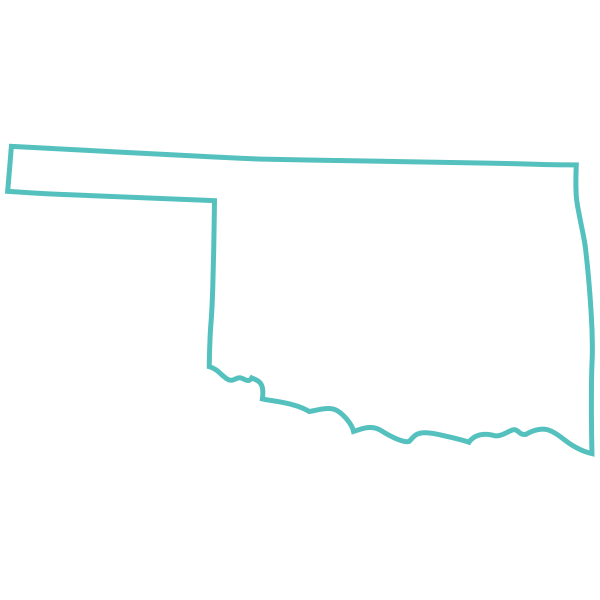
Parikh Financial proudly supports Oklahoma businesses with tailored, white-labeled financial services. From startups to established companies, we streamline finances, optimize taxes, and drive growth with expert bookkeeping, tax prep, and outsourced accounting.
Outsourced Services
Timely, accurate, compliant books so you can focus on running the business.
Explore →Stress-free preparation and filing for businesses across every industry.
Explore →AP, AR, payroll, and reporting handled end to end by our team.
Explore →Accurate cap tables and equity records as you raise and grow.
Explore →Scalable data pipelines that turn your numbers into decisions.
Explore →

Oklahoma levies a graduated personal income tax and a separate corporate income tax at a flat rate, and it imposes a statewide sales and use tax that cities and counties stack their own local rates on top of. Most state taxes are administered by the Oklahoma Tax Commission (OTC), while entity formation runs through the Secretary of State. A distinctive feature for hospitality operators is that Oklahoma has no broad statewide lodging tax, so occupancy taxes on rooms and sites are largely a city-and-county matter layered on top of regular sales tax.

And Accelerate Growth Across
Oklahoma
Oklahoma Business Tax Guide
Oklahoma levies a graduated personal income tax and a separate corporate income tax at a flat rate, and it imposes a statewide sales and use tax that cities and counties stack their own local rates on top of. Most state taxes are administered by the Oklahoma Tax Commission (OTC), while entity formation runs through the Secretary of State. A distinctive feature for hospitality operators is that Oklahoma has no broad statewide lodging tax, so occupancy taxes on rooms and sites are largely a city-and-county matter layered on top of regular sales tax.
Oklahoma has a personal income tax structured as a graduated tax with multiple brackets, and the legislature has discussed and enacted rate reductions in recent years, so owners should confirm the current bracket schedule with the Oklahoma Tax Commission each year. Income from pass-through entities such as S corporations, partnerships, and LLCs generally flows through to the owners' individual Oklahoma returns and is taxed at personal rates, with nonresident owners typically subject to Oklahoma tax on the share of income sourced to the state. Sole proprietors and single-member LLCs report business income on their personal Oklahoma return as well, which makes the individual return the central filing for most owner-operators here.
C corporations pay Oklahoma corporate income tax on income apportioned to the state at a flat corporate rate rather than a graduated schedule. Oklahoma historically imposed a separate annual franchise (capital) tax, but that tax was repealed, so corporations no longer face a standing franchise levy on capital employed in the state, though entity-level filing and registration obligations still apply. Oklahoma also offers a pass-through entity (PTE) tax election, letting eligible partnerships and S corporations elect to pay Oklahoma tax at the entity level as a workaround to the federal SALT deduction cap, which is worth modeling because the benefit depends on each owner's individual circumstances.
Oklahoma imposes a statewide sales and use tax, and on top of that cities and counties levy their own local sales taxes, so the combined rate a business charges varies by the exact location of the sale or delivery and Oklahoma's local-rate map is one of the more fragmented in the country. Remote and out-of-state sellers can trigger economic nexus once their Oklahoma sales cross the state's threshold, obligating them to register, collect, and remit even without a physical presence in the state. Marketplace facilitators are generally required to collect and remit Oklahoma tax on behalf of their third-party sellers, which affects how operators selling through online platforms should account for their own obligations.
Oklahoma does not impose a broad statewide lodging or occupancy tax, so the accommodation itself is generally subject to regular state and local sales tax, with any dedicated lodging tax coming from the city or county level rather than the state. Many Oklahoma municipalities and counties levy their own hotel or lodging (transient-guest) taxes, frequently earmarked to fund local tourism and convention promotion, and these are administered and remitted locally rather than through the Oklahoma Tax Commission. Because there is no single statewide lodging rule, a short-term rental, RV site, or cabin can face very different occupancy-tax treatment depending on the specific city or county it sits in, and booking platforms may collect sales tax while leaving local lodging taxes for the operator to register and remit directly.
Businesses operating in Oklahoma generally register with the Oklahoma Tax Commission for sales-and-use and withholding accounts and with the Secretary of State for entity formation and ongoing entity filings. Sales tax returns are typically filed on a recurring cadence, with the state assigning monthly, quarterly, or other filing frequency based on a business's tax volume, while any local hotel or lodging taxes are often filed and remitted separately to the relevant city or county. Because Oklahoma's local sales-tax jurisdictions and municipal lodging taxes are highly fragmented, keeping clean records of where revenue was earned, which jurisdiction applies, and what each platform already remitted is essential to filing correctly and surviving an audit.
Oklahoma's tourism draw around destinations like Lake Texoma, the Wichita Mountains, Route 66 towns, Broken Bow and the Ouachita region, and the state's many lakes and state parks puts campground, cabin, and RV-park operators squarely in the path of city and county lodging taxes that fund local destination marketing. Because the state itself does not run a unified lodging tax, two parks or rentals in neighboring jurisdictions can owe meaningfully different occupancy taxes, and some areas tax transient stays while others do not. Operators expanding across multiple Oklahoma communities should treat each city and county as its own compliance problem rather than assuming a single statewide lodging rule applies.
Parikh Financial keeps Oklahoma owner-operators clean across the state's fragmented local sales-tax map and its patchwork of city and county lodging taxes, tracking economic nexus, registering the right accounts, and reconciling what booking platforms already remit against what the operator still owes. For STR, campground, RV-park, and hospitality clients especially, we map every state and local tax layer so nothing slips through the cracks at audit time.
Book a CallTax rules and rates change. General information for Oklahoma operators, not tax advice — confirm current requirements with the Oklahoma Department of Revenue or your Parikh Financial advisor.